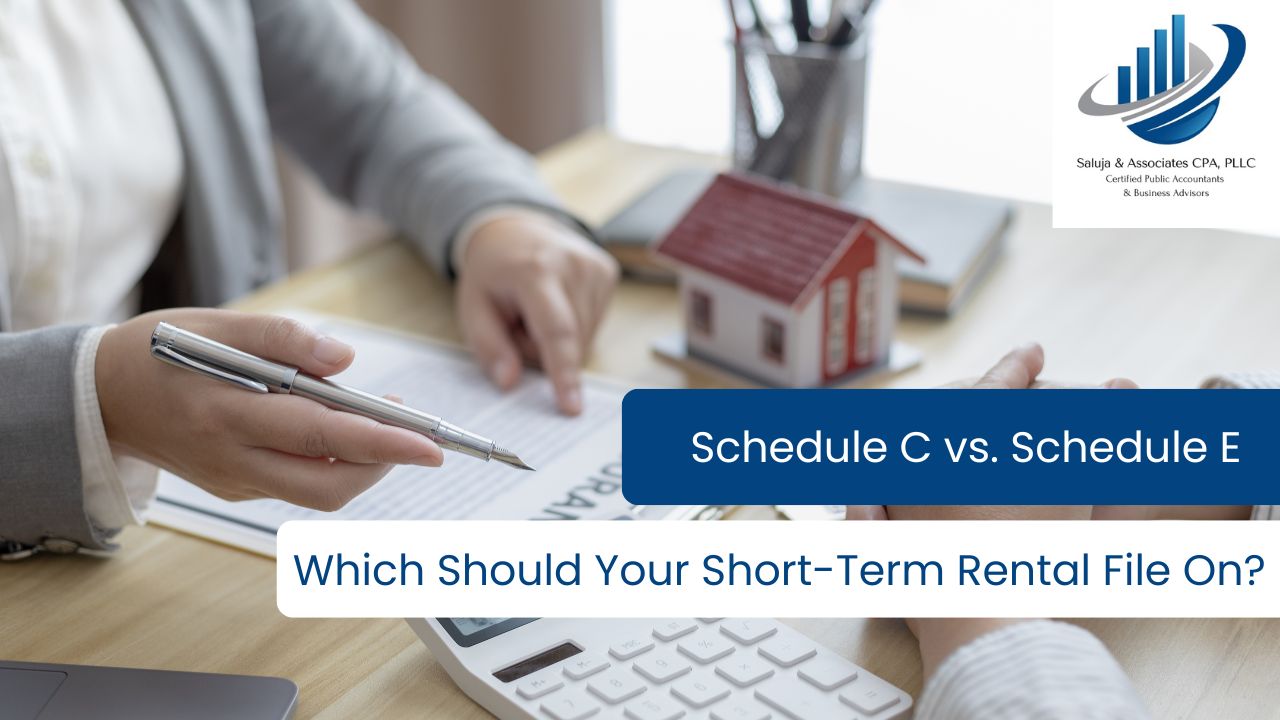
If you own a short-term rental in Houston, one of the most consequential and most misunderstood tax decisions you’ll make each year isn’t about deductions or depreciation. It’s about which IRS schedule your rental income belongs on: Schedule C or Schedule E.
Get it wrong, and you could overpay self-employment tax, lose out on valuable deductions, or trigger IRS scrutiny. Get it right, and you unlock one of the most talked-about strategies in real estate tax planning today. Here’s how to know which schedule applies to your property and why the answer isn’t always obvious.
Schedule E: The Default for Rental Income
Most rental property income is reported on Schedule E (Supplemental Income and Loss). This is the standard form for landlords, and it treats your rental as passive income. That means:
- No self-employment tax (15.3%) on rental profits
- Rental losses are generally subject to passive activity loss limitations
- Historically the default treatment for long-term and traditional rental arrangements
For a conventional 12-month lease, Schedule E is almost always correct. Short-term rentals, however, don’t always meet the definition of a “rental activity” under IRS rules and that’s where things get complicated.
Schedule C: When Your STR Becomes a “Trade or Business”
Schedule C (Profit or Loss from Business) applies when your rental activity is treated as a trade or business rather than passive rental income. Two common triggers push a short-term rental onto Schedule C:
1. The Average Stay Rule
If the average guest stay at your property is 7 days or less (or 30 days or less with “substantial services” provided, like daily cleaning, meals, or concierge-style amenities), the IRS does not classify the activity as a rental for tax purposes even though it feels like one.
2. Substantial Services
Even with longer average stays, if you provide hotel-like services daily housekeeping, linen changes, guest concierge support — the activity can be reclassified as a business.
Filing on Schedule C means:
- Income is subject to self-employment tax (15.3%) in most cases
- You can deduct business expenses more broadly
- Losses aren’t subject to the same passive activity limitations as Schedule E
Why This Distinction Matters for the STR Tax Strategy
Here’s the twist that makes this topic so important for real estate investors: the same “average stay under 7 days” rule that can push you onto Schedule C is also the mechanism behind the popular short-term rental tax loophole where non-real-estate professionals use STR losses to offset W-2 or active income.
The nuance: whether that activity lands on Schedule C or Schedule E, and whether you materially participate, changes how those losses can be used. This is precisely where DIY filing and generic tax software fall short the rules intersect with material participation, self-employment tax exposure, and passive activity loss rules in ways that are easy to get wrong.
Common Mistakes Houston STR Owners Make
- Assuming all rental income automatically goes on Schedule E
- Not tracking average guest stay length across the year
- Providing “substantial services” without realizing it reclassifies the activity
- Filing on Schedule E while claiming losses meant for active trade-or-business treatment
- Missing self-employment tax obligations when Schedule C applies
How a CPA Helps You File Correctly
A CPA experienced in short-term rental taxation will:
- Calculate your property’s average stay length correctly
- Determine whether services provided rise to the level of “substantial services”
- Advise on the right schedule based on your specific facts, not assumptions
- Structure your STR activity to align with your broader tax strategy, including material participation planning
- Ensure self-employment tax is calculated and paid correctly if Schedule C applies
Not Sure Which Schedule Your Short-Term Rental Belongs On?
The wrong filing decision can cost you in self-employment tax, missed deductions, or audit risk. Saluja & Associates CPA specializes in short-term rental tax strategy for Houston property owners. Schedule a consultation today and file with confidence.
Frequently Asked Questions
It depends on average guest stay length and services provided. If the average stay is 7 days or less, or 30 days or less with substantial services, it's typically Schedule C. Longer stays without hotel-like services usually stay on Schedule E.
Your filing should reflect the actual facts of your rental activity each year — average stay length and services provided can change year to year, which may change your filing classification.
A deduction reduces your taxable income, while a credit reduces your tax bill dollar-for-dollar. Credits, like the R&D credit, are generally more valuable than deductions of the same dollar amount.
It can. The tax strategies used to offset W-2 income rely on material participation rules that interact differently depending on how the activity is classified. This is a case where professional guidance matters.
Services beyond what a landlord typically provides — daily housekeeping, linen and towel changes, concierge services, or meals — can push a rental into "substantial services" territory, similar to a hotel.