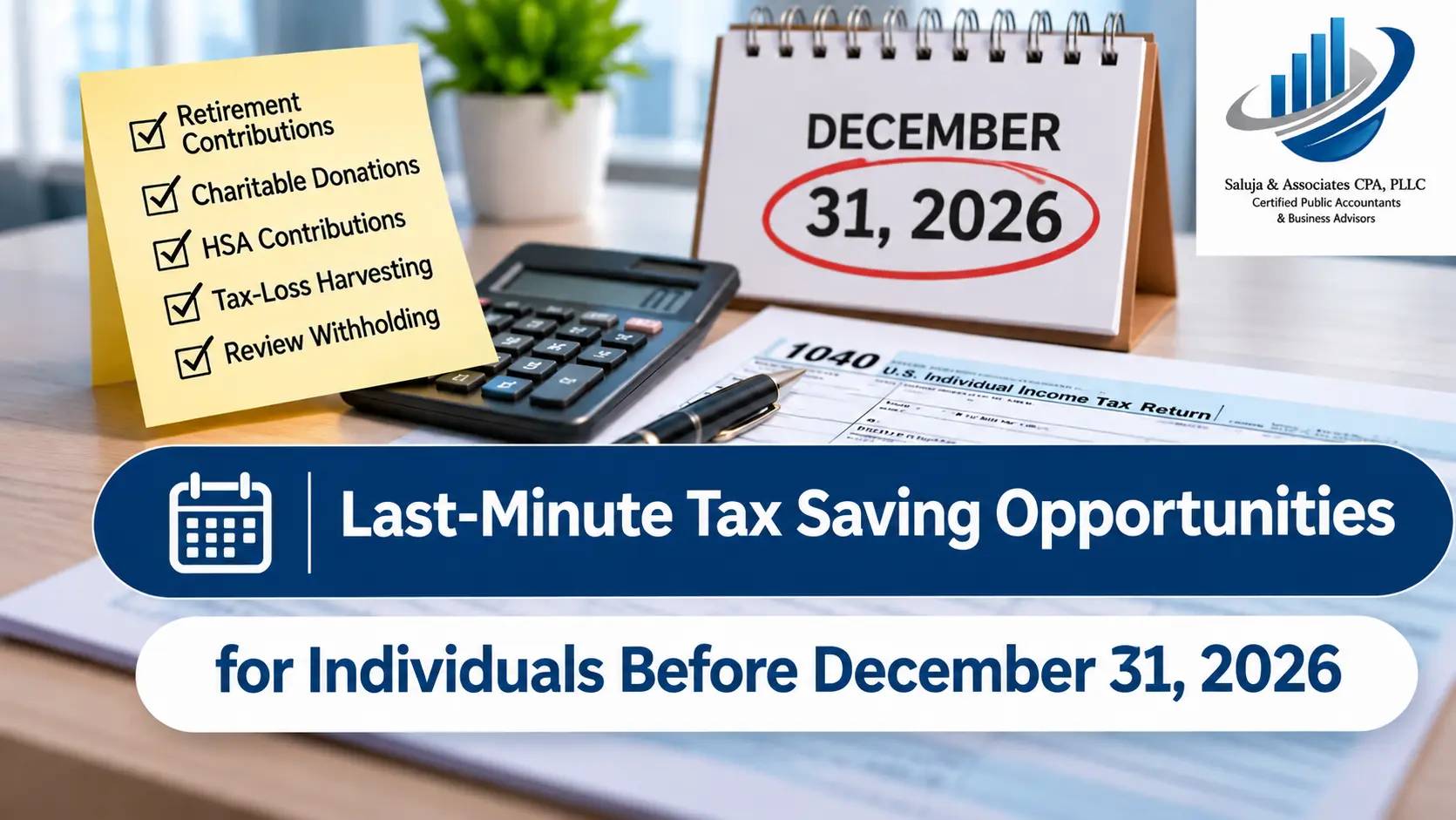
With December 31, 2026 approaching, there is still time to review your finances and identify potential tax-saving opportunities. Waiting until the 2027 tax filing season could mean missing deductions and strategies that require action before year-end.
Whether you are a salaried employee, self-employed professional, investor, or retiree, reviewing your income, expenses, and eligible deductions can help you manage your federal tax obligations.
At Saluja & Associates CPA, PLLC, we help individuals and families in Houston identify applicable tax-saving opportunities and prepare for the upcoming tax season.
1. Review Your Retirement Contributions
Contributing to eligible retirement accounts can help reduce taxable income while building long-term financial security.
For 2026, the employee contribution limit for most 401(k) plans is $24,500. Individuals aged 50 and older may qualify for additional catch-up contributions, with special rules for participants aged 60 through 63.
Traditional pre-tax 401(k) contributions generally reduce current federal taxable income, while Roth contributions do not provide an immediate income tax deduction.
What Should You Do Before Year-End?
- Review your current retirement contributions.
- Check your remaining contribution limits.
- Consider increasing contributions through remaining payroll periods.
- Review your eligibility for deductible traditional IRA contributions.
Traditional IRA contributions for 2026 can generally be made until April 15, 2027, although deductibility depends on income and retirement plan participation.
2. Take Advantage of the New Charitable Donation Deduction
Beginning in 2026, taxpayers who claim the standard deduction may also qualify for a deduction for eligible cash donations to qualifying charitable organizations.
- Individual filers: Up to $1,000.
- Married couples filing jointly: Up to $2,000.
This provides a potential tax benefit for individuals who do not itemize deductions. However, contributions to donor-advised funds and certain supporting organizations do not qualify for this particular deduction.
Taxpayers who itemize should also consider the new charitable deduction floor of 0.5% of adjusted gross income and other applicable limitations.
Year-end tax tip: Complete qualifying charitable donations before December 31, 2026, and retain receipts and supporting documentation.
3. Compare Standard and Itemized Deductions
Choosing the appropriate deduction method can affect your taxable income. Before year-end, compare your potential itemized deductions with the standard deduction available for your filing status.
2026 Federal Standard Deduction Amounts
| Filing Status | Standard Deduction |
|---|---|
| Single | $16,100 |
| Married Filing Jointly | $32,200 |
| Head of Household | $24,150 |
| Married Filing Separately | $16,100 |
Houston taxpayers considering itemized deductions should review expenses such as:
- Eligible mortgage interest.
- State and local property taxes.
- Qualifying state and local sales taxes.
- Eligible charitable contributions.
- Qualifying unreimbursed medical expenses.
For 2026, the general state and local tax (SALT) deduction limit is $40,400 for eligible itemizers, subject to income-based reductions and separate filing rules.
Since Texas does not impose an individual state income tax, eligible Houston taxpayers may benefit from reviewing deductible sales taxes alongside property taxes.
4. Consider Tax-Loss Harvesting
If you have investments in a taxable brokerage account, review assets that have declined in value. Selling qualifying investments at a loss before year-end may help offset capital gains realized during 2026.
When capital losses exceed capital gains, eligible taxpayers can generally deduct:
- Up to $3,000 against other income.
- Up to $1,500 if married filing separately.
- Remaining eligible losses in future tax years through capital loss carryforwards.
Be aware of the wash-sale rule, which can disallow a loss if substantially identical securities are purchased within 30 days before or after the sale.
Investment decisions should consider your overall financial objectives rather than potential tax savings alone.
5. Maximize Eligible Health Savings Account Contributions
A Health Savings Account (HSA) offers eligible individuals an opportunity to save for medical expenses while receiving potential tax benefits.
2026 HSA Contribution Limits
- Self-only coverage: $4,400.
- Family coverage: $8,750.
- Eligible individuals aged 55 or older: An additional $1,000 catch-up contribution.
These limits generally include employer contributions. Eligible personal HSA contributions may reduce taxable income, while withdrawals for qualified medical expenses can be tax-free.
Although 2026 HSA contributions can generally be made until April 15, 2027, reviewing your eligibility and contributions before year-end can help with financial planning.
6. Review New Federal Tax Deductions for Individuals
Several federal tax provisions introduced in 2025 remain available to eligible taxpayers in 2026.
Depending on your circumstances, you may qualify for deductions related to:
- Qualified tip income.
- Eligible overtime compensation.
- Qualifying vehicle loan interest.
- The enhanced deduction for eligible seniors aged 65 and older.
These deductions are subject to specific eligibility requirements, income limitations, and statutory caps. They do not automatically make all tips or overtime earnings tax-free.
Review the latest IRS guidance for individuals and workers to determine which provisions may apply to your 2026 federal income tax return.
7. Review Self-Employment Income and Business Expenses
Freelancers, consultants, independent contractors, and self-employed professionals should review their business income and eligible expenses before December 31.
Common deductible business expenses may include:
- Business mileage and qualifying travel expenses.
- Professional fees and software subscriptions.
- Office supplies and business equipment.
- Qualifying home office expenses.
Maintaining accurate records is particularly important for individuals who receive both employment and self-employment income.
For additional strategies, explore our year-end small business tax planning guide.
8. Check Tax Withholding and Estimated Payments
Review your federal income tax withholding, especially if your financial circumstances changed during 2026.
You may need to review your tax payments if you:
- Received a salary increase or year-end bonus.
- Earned additional self-employment income.
- Sold investments for a profit.
- Received income from multiple sources.
Adjusting withholding during remaining payroll periods or making an estimated tax payment may help reduce an unexpected tax balance or underpayment penalties.
The fourth-quarter estimated tax payment deadline for most calendar-year individual taxpayers is January 15, 2027. Estimated payments do not reduce taxable income but help cover your tax obligations.
Year-End Individual Tax Planning Checklist
Before December 31, 2026, take time to review the following financial and tax planning opportunities:
- Review retirement account contributions.
- Complete qualifying charitable donations.
- Compare standard and itemized deductions.
- Review investment gains and losses.
- Check HSA eligibility and contribution limits.
- Evaluate new federal tax deductions.
- Organize self-employment income and expense records.
- Review federal tax withholding and estimated payments.
- Consult a tax professional about applicable year-end strategies.
Taking these steps now can help simplify tax preparation and identify opportunities that may otherwise be overlooked. Visit our tax and accounting blog for additional financial guidance.
Professional Year-End Individual Tax Planning in Houston
Effective tax planning begins before tax filing season. Reviewing your finances now can help you identify eligible deductions, manage your tax obligations, and prepare for the 2027 tax filing season.
At Saluja & Associates CPA, PLLC, we provide individual tax preparation, tax planning, and financial advisory services for individuals, families, and self-employed professionals in Houston, Texas.
Don’t wait until tax season to explore your tax-saving opportunities. Contact our team to discuss your individual tax planning needs.
Saluja & Associates CPA, PLLC
Phone: (832) 848-5155
Schedule a Tax Planning Consultation
Frequently Asked Questions About Year-End Individual Tax Planning
Eligible retirement contributions, charitable donations, HSA contributions, and applicable tax deductions may help reduce taxable income.
Yes. Eligible non-itemizers may deduct qualifying cash donations up to $1,000, or $2,000 for married couples filing jointly.
Eligible IRA contributions for 2026 can generally be made until April 15, 2027. Employer-sponsored retirement plans have different deadlines.
Capital losses can offset capital gains and potentially reduce other taxable income by up to $3,000 annually, subject to applicable rules.
Contact a CPA before December 31 whenever possible, as several tax-saving strategies require action before the calendar year ends.